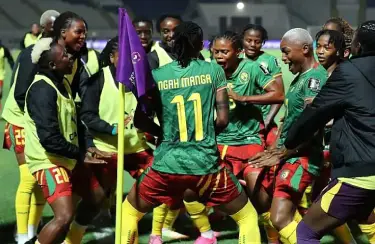
Cameroon won their first-ever WAFCON title after beating Malawi 3-0 in the 2026 Women’s Africa Cup of Nations final in Rabat, Morocco.
The Indomitable Lionesses took control in the 20th minute. Marie Ngah Manga headed home from close range to give Cameroon the lead.
Naomi Eto doubled the advantage in the 30th minute. She struck a superb volley to put Cameroon 2-0 ahead.
Cameroon added a third goal three minutes into first-half stoppage time. Eto dribbled past Malawi goalkeeper Mercy Sikelo before setting up Ngah Manga. The striker made no mistake and scored her fifth goal of the tournament.
Cameroon’s WAFCON title came after the team missed out on regular qualification. They entered the tournament after the expansion to 16 nations and secured their place through the FIFA Women’s World Ranking.
Cameroon named an unchanged starting lineup for the final. Malawi made one change after a red card in the semi-final. However, the Indomitable Lionesses dominated from the opening whistle.
Malawi entered the final as the lowest-ranked team at the tournament. They were ranked 153rd in the world. Their impressive run was driven by sisters Tabitha and Temwa Chawinga.
Veteran forward Gabrielle Onguene also celebrated a memorable moment. The 37-year-old featured in the 2016 final and came on during second-half stoppage time. The appearance was her eighth at WAFCON.
FIFA President Gianni Infantino and CAF President Patrice Motsepe presented Cameroon with the trophy. The victory ended Cameroon’s run of three final defeats. They also collected $2 million (£1.48 million) in prize money.
Cameroon became only the fourth nation to win the WAFCON title. They joined Nigeria, Equatorial Guinea and South Africa. Cameroon and Malawi will also represent Africa at the 2027 Women’s World Cup in Brazil, alongside Algeria and Morocco.
The WAFCON title ended Cameroon’s decade-long wait for continental glory. It also made them the second Central African nation to win the competition after Equatorial Guinea in 2012.